Learn Poultry Farming at Home: 2026 Beginner’s Guide

Why spend four years and thousands of dollars on a formal agricultural degree when you can learn poultry farming at home using your own backyard as a classroom? You’ve probably watched feed prices climb and wondered if you could turn your land into a source of steady income. It’s natural to feel overwhelmed by the technicalities of biosecurity or the fear of choosing the wrong breeds. You want to start, but the lack of a local mentor makes every step feel like a gamble.
We understand that the path to food security and financial independence should be accessible to everyone. This guide provides a structured, professional lens that cuts through the noise and gives you the tools to succeed. We’ll show you how to build a resilient flock with confidence and reduce your biggest expenses using innovative feed alternatives. From selecting your first chicks to scaling a profitable 2026 agribusiness, this is your blueprint for professional growth and success.
Key Takeaways
- Discover why you should learn poultry farming at home to build a low-risk, high-reward agribusiness without a massive initial investment.
- Master the selection of high-performing breeds and housing systems that maximize bird health in small, home-based environments.
- Establish a bulletproof daily management routine and biosecurity protocols to protect your flock from disease and early losses.
- Slash your primary overhead costs by integrating Black Soldier Fly larvae as a sustainable, high-protein feed alternative.
- Transition from a backyard hobbyist to a professional producer by mastering basic record-keeping and local marketing strategies.
Why Learning Poultry Farming at Home is Your Best Move in 2026
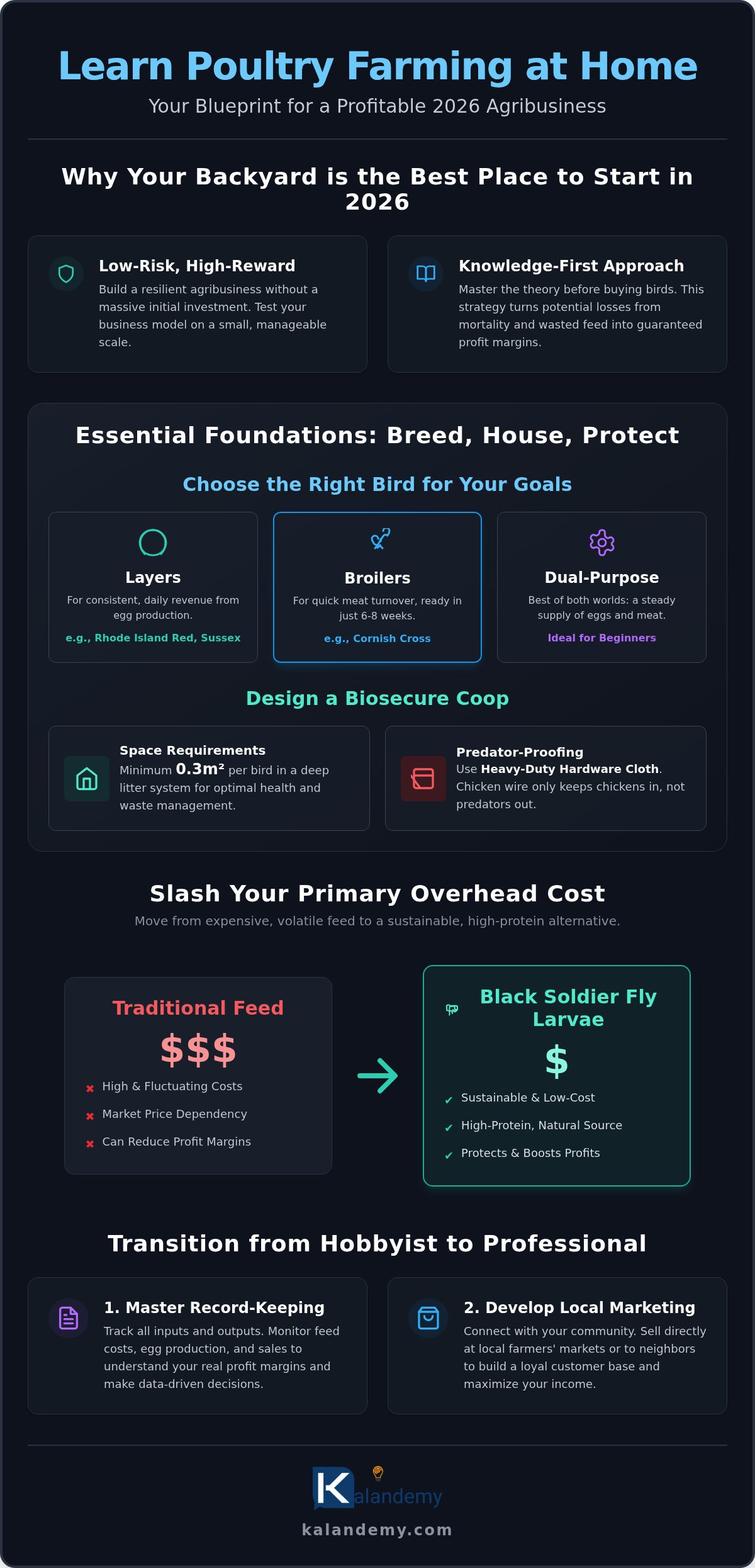
Agribusiness isn’t just for massive corporations with endless hectares of land anymore. In 2026, the most successful agricultural entrepreneurs start right in their backyards. Choosing to learn poultry farming at home represents a strategic, low-barrier entry into a sector that remains recession-proof. It’s a scalable model where your growth is limited only by your willingness to master the basics before spending a single cent on livestock.
Most beginners fail because they rush into purchasing birds without a solid plan. They face high mortality rates and wasted feed costs because they lacked a theoretical foundation. We champion a “learn before you buy” philosophy. By mastering the theory first, you turn potential losses into guaranteed profit margins. This digital-first approach to agricultural education is the defining trend of 2026, allowing you to bypass expensive degrees and get straight to the practical, income-generating skills. The initial capital requirements are minimal, making it the perfect side hustle or full-time career pivot.
The Advantages of Small-Scale Home Production
Starting small offers a level of agility that commercial farms envy. You don’t need a massive capital injection to get started; a modest backyard space is often enough to house a high-performing flock. This intimate setup allows for direct control over biosecurity, which is your primary defense against disease. A Poultry farming overview reveals that disease management is the biggest hurdle in the industry, and at home, you can monitor every bird individually.
Home production also serves as the perfect testing ground for your business ideas. You can experiment with different breeds and local marketing strategies without the pressure of massive overhead. It’s about proving your business model on a small scale before you commit to a full-scale commercial operation. You’ll learn the nuances of bird behavior and health in an environment where mistakes are manageable rather than catastrophic.
Overcoming the “Experience Gap” with Digital Training
The old way of learning involved years of trial and error or expensive, time-consuming apprenticeships. Today, professional digital training bridges that gap in just a few weeks. When you learn poultry farming at home through expert-led courses, you’re essentially downloading decades of field experience directly into your workflow. It’s about working smarter, not harder.
Lifetime access to video training means you have a mentor in your pocket at all times. If a bird shows signs of distress or if you’re unsure about feed ratios, the answer is just a click away. This transition from a hobbyist mindset to an entrepreneurial one is what separates those who struggle from those who thrive. You aren’t just raising chickens; you’re managing a biological asset that produces daily revenue. Mastering this mindset early ensures that your home-based farm remains profitable and sustainable for years to come.
Essential Foundations: Breeds, Housing, and Equipment
You’ve decided to take the leap. Now, you need to build the engine that will drive your agribusiness. To learn poultry farming at home properly, you must move past the idea of just keeping chickens. You’re designing a production environment. Your choices here will determine whether you spend your mornings collecting profits or dealing with avoidable disasters. Your infrastructure is the single biggest factor in flock health and long-term sustainability.
Choosing the Right Bird for Your Home Goals
Success starts with the right genetics. If you want daily revenue, Layers like Rhode Island Reds or Sussex are your best friends. They’re resilient and produce consistently. If you’re looking for quick meat turnover, Broilers like the Cornish Cross reach market weight in just 6 to 8 weeks. For most home-based beginners, dual-purpose breeds offer the best of both worlds. They provide a steady egg supply while maintaining enough bulk for meat if you decide to cull. Pick the bird that aligns with your 2026 financial goals and space availability.
Designing Your First Backyard Coop
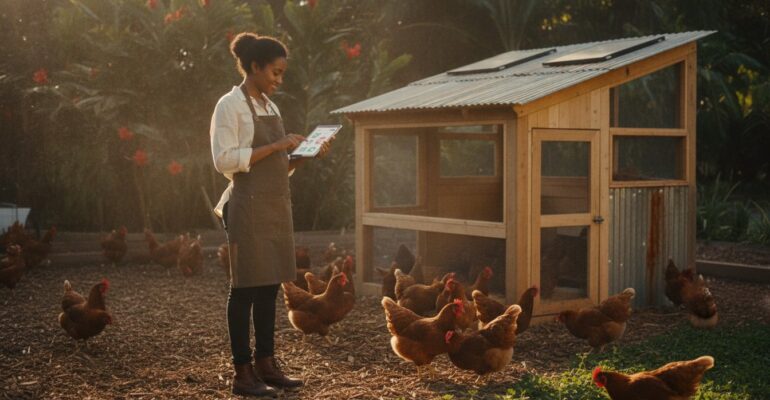
Your coop is more than a shelter; it’s a biosecurity fortress. Aim for at least 0.3 square meters of floor space per bird in a deep litter system. This method is often superior to battery cages for home use because it manages waste naturally and keeps odors down. Protecting your investment means predator-proofing with heavy-duty hardware cloth. Chicken wire is for keeping chickens in, not for keeping predators out. You need a perimeter that can withstand determined burrowers and climbers.
Proper manure management is vital for keeping your neighbors happy and your birds healthy. According to NDSU’s Beginner’s Guide to Raising Chickens, purchasing NPIP certified disease-free chicks is the first step in a solid biosecurity plan. Once they arrive, your equipment must be ready. You’ll need high-quality feeders, gravity-fed drinkers, and reliable heat lamps for the brooding stage. Don’t overlook ventilation. Stale air kills birds faster than the cold does. Ensure a constant flow of fresh air without creating direct drafts on the flock.
Lighting is your secret weapon for egg production. Layers need 14 to 16 hours of light to maintain their cycle during shorter winter days. Without a simple timer and a basic LED setup, your production will drop and your profit margins will vanish. Combine this with feeders kept off the ground to prevent waste, and you’ve already outperformed 90% of hobbyists. This transition to a professional setup is exactly why people choose to learn poultry farming at home through structured programs rather than guessing. If you’re ready to dive deeper into the specifics of egg production, our Complete Guide to Profitable Layer Chicken Farming provides the technical blueprints you need to scale with confidence.
Master Daily Management: Feeding, Health, and Biosecurity
Management is the heartbeat of your agribusiness. You can have the most expensive coop in the world, but if your daily operations are sloppy, your profit margins will bleed out. When you learn poultry farming at home, you must adopt the discipline of a professional producer from day one. This means moving beyond “feeding the chickens” and embracing a structured system that ensures every bird is performing at its peak.
Your “Poultry Morning Routine” is your most powerful tool. Start every day by checking water levels before anything else. A bird that goes without water for even a few hours will stop laying eggs or lose weight rapidly. Observe your flock for a few minutes before you fill the feeders. Are they active? Are they vocal? Healthy birds are alert and greedy for food. If you notice a bird huddling in a corner or looking lethargic, you’ve caught a potential issue before it becomes a flock-wide crisis. In 2026, we don’t wait for birds to get sick; we use preventative vaccination schedules and high-quality nutrition to keep their immune systems bulletproof.
Revolutionary Feed Cost Reduction: The BSF Advantage
Commercial feed is the single biggest expense for any poultry farmer, often accounting for over 70% of total operational costs. If you want to maximize your revenue, you have to think outside the bag. Integrating Black Soldier Fly farming into your home setup is the most effective way to slash these overheads. These larvae are a sustainable, high-protein powerhouse that you can grow using organic kitchen waste.
By supplementing your flock’s diet with BSF maggots, you can reduce your reliance on expensive commercial concentrates by up to 40%. It’s a “waste to wealth” model that turns your household scraps into high-quality poultry meat and eggs. This level of self-sufficiency is exactly why more people are choosing to learn poultry farming at home today. You aren’t just raising birds; you’re building a circular economy in your own backyard.
Identifying and Preventing Common Poultry Diseases
Biosecurity is your primary defense. It’s a series of habits that keep pathogens away from your flock. For a home-based farm, this starts with a simple “footbath” at the entrance of your coop. Anyone entering must dip their shoes in a disinfectant solution to prevent tracking in bacteria from the outside world. Limit visitors to your poultry area; your birds don’t need “tourists” who might bring in respiratory infections or parasites.
You must be able to recognize early warning signs like drooping wings, unusual respiratory sounds, or discolored droppings. Keep a basic poultry first-aid kit ready at all times. This should include electrolytes for heat stress, iodine for minor wounds, and a broad-spectrum antibiotic if your local regulations allow for its use. Being prepared means you can isolate a sick bird immediately, protecting the rest of your investment and ensuring your home-based business continues to thrive without interruption.
From Backyard to Business: Scaling and Profitability
Turning your backyard into a revenue stream is where the real excitement begins. Many people learn poultry farming at home as a hobby, but the real winners are those who treat it like a professional agribusiness from day one. Transitioning from a small flock to a profitable enterprise requires a shift in focus from bird health alone to financial data and market positioning. Your goal in 2026 is to build a system that pays for itself and eventually replaces your primary income.
Don’t guess your profits; track them. Effective record-keeping is the difference between a successful farm and an expensive hobby. You must log every expense, from the smallest bag of sawdust to the largest vaccination batch. Compare these costs against your revenue from egg and meat sales. This data allows you to identify leaks in your budget and double down on what works. If you find your backyard setup is consistently hitting its limits, it might be time to look at a commercial poultry farm in Nigeria or your local region to scale your operations professionally.
Mastering the Economics of Your Home Farm
Efficiency is the only way to survive in a competitive market. You need to calculate your Feed Conversion Ratio (FCR) regularly. This metric tells you exactly how much feed it takes to produce a kilogram of meat or a dozen eggs. If your FCR is too high, you’re literally flushing money away. Pricing your products is equally critical. Don’t just match the local supermarket; factor in the “home-grown” premium. People are willing to pay more for birds raised with care and transparency. Reinvest your initial profits into better equipment or more birds to ensure sustainable, gradual expansion without taking on unnecessary debt.
Digital Marketing for the Modern Poultry Farmer
Your neighbors are your first loyal customers, but digital platforms are your growth engine. Use WhatsApp status updates and local Facebook groups to announce when your next batch of eggs is ready. The power of storytelling is your secret weapon. Share photos of your clean coop and healthy birds to sell the benefits of “organic” and “freshly harvested” produce. Building a waitlist for your next harvest ensures that your birds are sold before they even reach market weight, eliminating the cost of keeping mature birds longer than necessary.
Value addition is another way to skyrocket your margins. Selling a live bird is a simple transaction, but selling cleaned, packaged, and portioned meat is a brand. This extra effort can significantly increase your profit per bird. If you’re serious about turning these insights into a full-scale career, enroll in our Complete Guide to Profitable Layer Chicken Farming to master the advanced business strategies used by the world’s top producers.
Why Digital Training is the Fastest Path to Poultry Success
Trial and error is the most expensive classroom in the world of agribusiness. In poultry farming, a single mistake in ventilation or a missed vaccination can result in 100% mortality for your batch. When you decide to learn poultry farming at home, you can’t afford to guess. Digital training offers a professional shortcut that replaces years of painful struggle with a few weeks of structured guidance. It’s about leveraging the experience of others to protect your capital. You can access these expert insights on your smartphone while you’re actually in the coop, allowing you to make real-time adjustments that save both money and bird lives.
The traditional method of learning through local mentorship is often inconsistent and slow. In 2026, the most successful home-based farmers use a digital-first approach to stay ahead of market trends and disease outbreaks. This method allows you to master the theory before you risk a single dollar on livestock. By the time your first chicks arrive, you already have the confidence of a seasoned producer because you’ve seen the process documented from start to finish. It’s the most efficient way to bridge the gap between curiosity and a profitable revenue stream.
The Kalandemy Difference: Practical, Results-Oriented Learning
We provide a results-oriented framework that turns beginners into professionals. Our Profitable Layer Chicken Farming guide is a comprehensive blueprint designed to eliminate the uncertainty of egg production. You’ll move beyond the basics and master the technical nuances of lighting, nutrition, and disease prevention. Upon completion, you receive a certificate that validates your expertise and helps you build professional credibility with suppliers. You also gain access to a global network of agricultural entrepreneurs, ensuring you never have to solve a problem in isolation.
Your 30-Day Action Plan to Start
- Week 1: Immerse yourself in digital education. Finish your core training modules and perform a deep dive into your local market. Identify which restaurants or neighbors are looking for fresh, home-grown produce.
- Week 2: Prepare your physical infrastructure. Source high-quality equipment and set up your brooding area. Focus on predator-proofing and ensuring your ventilation system is flawless.
- Week 3: Secure your livestock. Source your birds from a reputable hatchery. Finalize your biosecurity footbaths and organize your digital record-keeping folders.
- Week 4: Launch your operation. Start your daily management routine and record every gram of feed used. Begin your social media marketing to build a waitlist for your first eggs or meat.
Stop waiting for permission to build the life you want. The technology and knowledge available in 2026 have democratized success in agriculture. You have the space, you have the interest, and now you have the roadmap. Take the definitive next step in your agribusiness journey today. By choosing to learn poultry farming at home with a mentor-led approach, you aren’t just starting a farm; you’re launching a legacy of financial independence.
Your Agribusiness Legacy Starts Today
Building a successful farm requires more than just passion. It demands a professional strategy. You’ve seen how selecting the right breeds and mastering biosecurity can protect your investment from day one. By integrating sustainable solutions like Black Soldier Fly larvae, you’ve learned how to turn the biggest expense into your greatest competitive advantage. When you learn poultry farming at home, you aren’t just raising birds; you’re developing a high-value skill that pays daily dividends.
The transition from a backyard enthusiast to a professional producer is now within your reach. Our platform provides the exact roadmap you need to bypass expensive mistakes and secure your financial future. Unlock your agricultural potential with our Complete Guide to Profitable Layer Chicken Farming! You’ll gain lifetime access to expert-led video modules, downloadable agribusiness resources, and sharable professional certificates to showcase your mastery. The tools for global success are in your hands. Take the leap and start building your profitable agribusiness right now.
Frequently Asked Questions
Is poultry farming at home profitable for beginners?
Yes, home-based poultry production is highly profitable if you manage your overhead effectively. Beginners often see immediate returns by selling fresh eggs to neighbors or local restaurants. To ensure success, you must master the economics of feed and mortality rates early. Using innovative methods like Black Soldier Fly farming can slash your expenses by up to 40%, directly increasing your take-home profit and making your small-scale agribusiness sustainable.
How much space do I need to start a poultry farm at home?
You don’t need a massive estate to get started. For a standard deep litter system, you should allocate approximately 0.3 square meters of floor space per bird. If you’re starting with a small flock of 10 to 20 chickens, a modest backyard corner or a repurposed shed is often sufficient. The key is ensuring your birds have enough room to move freely without overcrowding, which prevents stress and disease.
Can I learn poultry farming online without any practical experience?
Absolutely, and it’s actually the safest way to begin. When you choose to learn poultry farming at home through digital courses, you gain the theoretical mastery needed to prevent expensive beginner mistakes. Professional video modules simulate years of field experience, showing you exactly how to handle birds, manage biosecurity, and optimize nutrition. This theory-first approach ensures that your first physical investment in livestock is backed by a professional foundation.
What are the most common mistakes beginners make in poultry farming?
The most catastrophic errors include poor biosecurity and neglecting ventilation. Many beginners also fail because they guess their feed ratios instead of using scientifically balanced nutrition. Overcrowding is another common pitfall that leads to rapid disease spread and high mortality. By following a structured training program, you’ll learn to recognize these red flags before they impact your flock, ensuring your agribusiness remains stable and productive from the very first batch.
How much capital is required to start a small home poultry farm?
Capital requirements for home setups are remarkably low compared to commercial operations. You’ll need to fund your initial flock, a secure coop, and a starting supply of feed. While exact costs vary by region, starting with a small batch of layers or broilers is accessible for most entrepreneurs. Focus on building a functional, predator-proof environment first. You can always reinvest your early profits to scale your operation gradually as your experience grows.
How do I reduce the smell of chickens in a residential area?
Odor management is essential for maintaining good relations with your neighbors. You can effectively reduce smells by using a well-managed deep litter system with dry, carbon-rich bedding like wood shavings or rice husks. Keeping the litter dry is the secret; moisture is what causes ammonia buildup. Regular cleaning and proper ventilation ensure that your home farm remains a clean, professional environment that doesn’t disrupt the peace of your neighborhood.
What is the best breed of chicken for a backyard egg business?
If your goal is consistent egg revenue, Rhode Island Reds and Sussex are top-tier choices for home environments. These breeds are hardy, adaptable, and produce high numbers of large eggs. For maximum efficiency, many home farmers also consider hybrids like ISA Browns, which are specifically bred for high-volume egg production. Choosing the right breed ensures that your daily management efforts result in the highest possible yield and a steady income stream.
Do I need a license to keep chickens at home?
Licensing requirements depend entirely on your specific location and local municipal laws. In many regions, keeping a small flock for personal use or limited local sale doesn’t require a commercial license. However, you should always check your local zoning regulations regarding bird counts and housing structures. Staying compliant from the start protects your agribusiness and ensures you can operate with total confidence when you learn poultry farming at home.