How to Start a Poultry Farm in Nigeria: The 2026 Success Blueprint

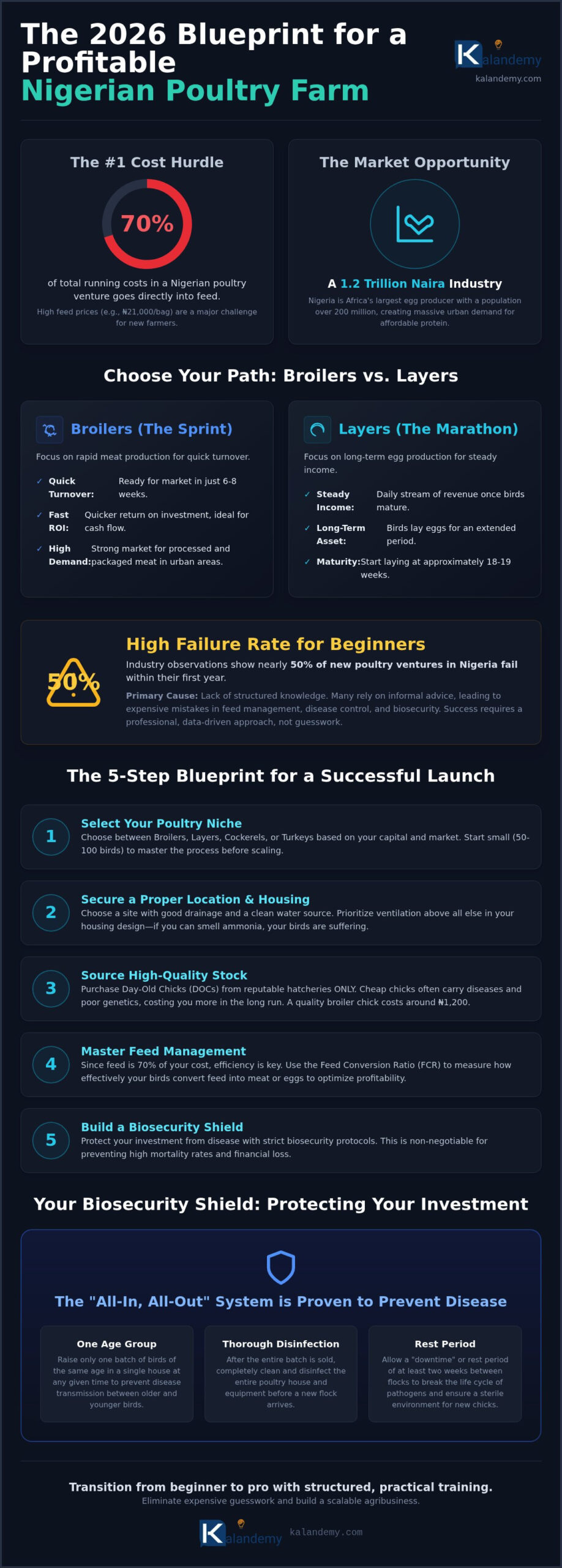
Seventy percent of your total running costs in a Nigerian poultry venture will go directly into feed bags. It’s a staggering figure that stops many aspiring farmers before they even buy their first bird. You’ve likely felt the pressure of ₦21,000 feed prices or worried about losing your entire investment to a sudden disease outbreak. You aren’t alone in these frustrations. Most beginners struggle with high mortality rates and a lack of practical, structured training to protect their capital.
The good news is that success isn’t about luck. It’s about strategy. This guide will show you exactly how to start poultry farm nigeria by focusing on technical mastery and feed efficiency. We’ll help you move past expensive mistakes so you can build a scalable agribusiness that generates steady income. You’ll discover the essentials of bird health, biosecurity secrets, and smart ways to slash overhead. We are breaking down the 2026 blueprint for a profitable farm, covering everything from CAC registration to choosing the right birds for your specific financial goals.
Key Takeaways
- Identify why Nigeria’s expanding urban demand makes 2026 the perfect window to launch your professional agribusiness.
- Master the five essential steps on how to start poultry farm nigeria, focusing on niche selection and strategic site management.
- Learn to control your biggest expense by using the Feed Conversion Ratio to optimize feed efficiency and maximize your ROI.
- Protect your investment with a robust biosecurity shield and the proven “all-in, all-out” system to prevent disease.
- Transition from a struggling beginner to a professional farmer by using structured, practical training that eliminates expensive guesswork.
The Poultry Opportunity in Nigeria: Why Start in 2026?
Nigeria is currently the largest egg producer in Africa. With a population exceeding 200 million, the demand for affordable protein in cities like Lagos, Abuja, and Kano has never been higher. For the modern entrepreneur, learning how to start poultry farm nigeria isn’t just about farming. It’s about tapping into a 1.2 trillion Naira industry. While the economy presents challenges, it also creates massive gaps for those who approach agribusiness with a digital-first, professional mindset.
The broader landscape of Agriculture in Nigeria is shifting toward technology and efficiency. You aren’t just raising birds; you’re managing a high-stakes production line. Success in 2026 requires more than just capital. It requires a strategy to navigate the “Feed Crisis.” Since feed accounts for roughly 70% of your costs, the unprepared often get crushed by rising maize prices. But for those who master management, these hurdles become a filter that removes the competition. Understanding how to start poultry farm nigeria requires a shift from traditional methods to data-driven management.
Market Demand: Eggs vs. Meat
You need to decide your path early. Layer farming is the marathon. It provides a daily stream of active income once birds reach maturity at 18-19 weeks. Broilers are the sprint. They offer a quick turnover and ROI in just 6-8 weeks. We’re also seeing a surge in Noiler breeds, which are perfect for rural markets due to their hardiness. Beyond raw sales, the real growth in 2026 lies in processed poultry. Pre-packaged, cleaned, and branded meat is what busy urban dwellers want. It’s a premium market waiting for professional players who can provide quality and consistency.
The Role of Knowledge in Avoiding “Poultry Failure”
Industry observations suggest that nearly 50% of new poultry ventures in Nigeria close within their first year. This happens because most owners rely on “informal learning.” They take vague advice from neighbors or unverified social media clips. Don’t make that mistake. Knowledge is the only valuta that doesn’t depreciate. Success is a choice backed by the right tools. Instead of expensive trial and error, structured training like the “Complete Guide to Profitable Layer Chicken Farming” provides a proven blueprint. Digital entrepreneurs are realizing that a small investment in expertise prevents a massive loss in capital. You can’t afford to learn on the job when lives and money are at stake. If you prefer a more flexible approach, you can learn poultry farming at home using your own backyard as a classroom, cutting through the noise with structured, professional guidance designed for 2026.
5 Essential Steps to Launch Your Poultry Farm
Turning your vision into a reality requires a disciplined, step-by-step approach. If you’re figuring out how to start poultry farm nigeria, you must move from abstract ideas to concrete actions. Success doesn’t happen by accident; it’s the result of meticulous planning and execution from day one. Follow these five pillars to build a foundation that lasts.
Selecting Your Poultry Niche
Choosing your bird is your first strategic decision. Broilers provide quick meat turnover in 6 to 8 weeks, while Layers offer long-term egg revenue starting around week 19. Cockerels and Turkeys are hardy alternatives, though they require more patience. We recommend starting small with 50 to 100 birds. This allows you to master the learning curve without risking massive capital. A solid, written business plan is your roadmap for growth. According to the FAO report on Nigerian poultry, small to medium-scale systems dominate the landscape, making niche selection critical for local market fit and cash flow management.
Location and Housing Essentials
Your farm’s site determines your operational ease. Rural areas offer cheaper land and fewer neighbor complaints, while semi-urban spots keep you closer to high-demand markets. Ensure your land has excellent drainage to prevent flooding and a reliable source of clean water. For Layers, you’ll choose between the Deep Litter System and the Battery Cage System. Both have merits, but your housing must prioritize the Golden Rule of Ventilation: “If you can smell ammonia, your birds are already suffering.” Prioritize airflow over fancy brickwork to keep mortality rates low and birds healthy. Mastering these housing dynamics is a core part of the Complete Guide to Profitable Layer Chicken Farming.
Don’t cut corners when sourcing your stock. Buy day-old chicks (DOCs) from reputable hatcheries only. Currently, a quality broiler chick costs around ₦1,200. Cheap chicks often carry hidden diseases or poor genetics that will haunt your profit margins later. Once your birds arrive, your vaccination and feeding schedule must be airtight. Implement a strict “All-In, All-Out” system to manage health risks. Every day of delay in medication or nutrition is a day of lost growth. By following a structured 2026 blueprint on how to start poultry farm nigeria, you ensure that your investment is protected by science rather than luck.
Mastering Feed Costs and Management Ratios
Feed is the most significant line item in your accounting books. In the Nigerian context, feed accounts for 70% to 80% of total production costs. This is why mastering your Feed Conversion Ratio (FCR) is the difference between a thriving farm and a bankrupt one. FCR tells you exactly how many kilograms of feed are required to produce one kilogram of weight gain or a dozen eggs. If your FCR is high, your profits are literally evaporating into thin air. You must track every gram to ensure your birds are turning grain into gold.
Many beginners learning how to start poultry farm nigeria fall into the trap of buying “cheap” unbranded feed. This is a fatal mistake. Low-quality feed often lacks the essential amino acids and energy density required for modern bird genetics. You might save money at the point of purchase, but you’ll pay for it with stunted growth, weak shells, and high mortality. High-quality commercial brands provide a predictable nutritional profile that keeps your birds on track. Research into Poultry production systems in Nigeria shows that intensive systems require this level of nutritional precision to bridge the gap between local production and the massive urban demand in 2026. If you want to go further and reduce poultry feed costs naturally by up to 40% without compromising your flock’s health, a field-tested profitability checklist can show you exactly how to feed smarter rather than just cheaper.
The Black Soldier Fly (BSF) Revolution
Stop being a victim of fluctuating maize and soy prices. The competitive edge for 2026 farmers lies in protein self-sufficiency. Black Soldier Fly (BSF) larvae are a game-changer for the Nigerian market. These larvae can replace 30% to 50% of expensive soy or fishmeal in your bird’s diet without compromising growth rates. This is the ultimate “Waste to Wealth” strategy. You use organic waste to grow high-protein larvae, effectively slashing your feed bill by nearly half. It’s not just a sustainable practice; it’s a financial shield against inflation. If you want to master how to start poultry farm nigeria, you must look beyond the bag and start producing your own protein.
Water and Supplement Management
Clean water is just as important as the feed itself. If your water is contaminated or has an imbalanced pH, your birds won’t digest their feed efficiently, leading to wasted money. Success requires a disciplined approach to supplements:
- Multivitamins: Use these to boost immunity during stress periods like heatwaves, vaccinations, or bird transport.
- Antibiotics: These are for targeted treatment. They are never a substitute for poor hygiene or a lack of biosecurity.
- Feed Storage: Always store your feed in a cool, dry place. Damp bags lead to aflatoxin poisoning, which can wipe out a healthy flock in a matter of days.
Mastering these management ratios ensures your birds stay healthy and your bank account stays green. Focus on technical efficiency, and the growth of your agribusiness will follow naturally.
Biosecurity: Protecting Your Investment from Disease
Biosecurity is not just a cleaning chore; it is the physical shield protecting your capital. In the high-stakes environment of Nigerian agribusiness, a single outbreak can wipe out your entire flock in 48 hours. When you are learning how to start poultry farm nigeria, you must treat your farm like a high-security zone. Most failures occur because farmers treat hygiene as an afterthought rather than a core business strategy. Your goal is to create a barrier that pathogens cannot cross.
The “All-In, All-Out” system is the gold standard for management. This means you bring in a specific batch of birds, grow them, and sell the entire group before bringing in new chicks. This break in production allows you to deep-clean the pens and break the life cycle of lingering diseases. You must also be aware of the “Big Three” Nigerian poultry threats: Newcastle Disease, Gumboro (Infectious Bursal Disease), and Coccidiosis. Newcastle and Gumboro are viral and can be devastating, while Coccidiosis is a parasitic infection often caused by damp litter. Prevention is your only profitable option.
The Mandatory Vaccination Schedule
Your vaccination timeline is your most important calendar. Broilers usually require a fast-tracked schedule focusing on Gumboro and Newcastle within the first four weeks. Layers require a more extensive plan that includes Fowl Pox and Fowl Typhoid vaccines. However, the vaccine is only as good as its handling. You must maintain the “Cold Chain” at all times. The cold chain is a temperature-controlled supply chain that ensures vaccines remain potent by maintaining a constant range of 2°C to 8°C from production to administration. If the vaccine gets warm during transport from the vet shop to your farm, it becomes useless water. Always use a dedicated cooler box with ice packs for transport.
Daily Farm Hygiene Practices
Consistency is the secret to a healthy flock. You don’t need expensive equipment, but you do need strict discipline. Implement these practices immediately:
- Footbaths: Place a plastic tub with a strong disinfectant solution at the entrance of every pen. Every person must dip their boots before entering.
- No-Visitor Policy: Friends and family are the biggest carriers of disease. Keep a strict logbook and don’t allow anyone into the pens who doesn’t work there.
- Carcass Disposal: If a bird dies, don’t throw it in the trash. Burn it or bury it deep, at least 100 meters away from your pens, to prevent attracting flies and scavengers.
- Litter Management: Keep your wood shavings bone-dry. Wet litter releases ammonia, which burns the birds’ lungs and invites Coccidiosis.
Protecting your birds requires more than just luck. It requires the technical mastery found in structured training on biosecurity. By mastering these protocols, you ensure that your journey in how to start poultry farm nigeria leads to a scalable, healthy, and highly profitable enterprise.
Scaling Up: How Kalandemy Turns Beginners into Pros
Many aspiring entrepreneurs believe they can master the complexities of agribusiness through a few random YouTube clips or blog posts. While free content offers a starting point, it’s a dangerous foundation for a high-stakes business. In an environment where a single day-old chick costs ₦1,200 and a bag of feed is ₦21,000, “guessing” is a recipe for bankruptcy. You need more than just tips; you need a structured, professional system. Your farm’s growth is limited only by your knowledge, and in 2026, that knowledge must be precise and practical.
Kalandemy bridges the gap between curiosity and professional mastery. We don’t just provide information; we offer a digital mentorship experience designed for the African landscape. Our flagship training, the Complete Guide to Profitable Layer Chicken Farming, serves as a comprehensive roadmap. It moves you past the “how-to” and into the “why” of every management decision. With lifetime access on any device, you can double-check your brooding temperatures or vaccination protocols right from the poultry pen. This accessibility ensures that expert guidance is always within reach when you are implementing your plan on how to start poultry farm nigeria.
Structured Learning vs. Trial and Error
Trial and error is the most expensive way to learn in the livestock industry. A single mistake during the critical first 14 days of brooding can cause stunted growth that haunts your profit margins for the entire life of the flock. Kalandemy’s courses provide a step-by-step roadmap to avoid these common, yet costly, errors. We focus on high-income skills like feed formulation and biosecurity management. For those looking to diversify their income, we even offer a Resell Rights option. This allows you to start your own education business alongside your farm, turning your expertise into a second stream of active revenue. For farmers who want maximum flexibility, our resources also make it possible to learn poultry farming at home at your own pace, using your existing space as a practical training ground before scaling to a full commercial operation.
Next Steps: From Reading to Doing
The transition from a reader to a successful farm owner happens the moment you commit to professional training. Don’t let the fear of feed prices or disease outbreaks stop your progress. Instead, arm yourself with the tools used by industry leaders. By starting with our Complete Guide to Profitable Layer Chicken Farming, you are choosing a path of technical mastery over expensive guesswork. Unleash your potential as a successful Nigerian agribusiness leader today. Your journey in how to start poultry farm nigeria deserves a foundation built on proven results and structured expertise. The market for affordable protein is waiting; it’s time for you to lead it.
Take Command of Your Agribusiness Future
You now have the technical blueprint to navigate the 2026 Nigerian poultry market with confidence. Success isn’t just about owning birds; it’s about mastering feed efficiency and maintaining an unbreakable biosecurity shield. By focusing on your Feed Conversion Ratio and implementing a strict vaccination schedule, you turn potential risks into predictable growth. Knowledge is the ultimate currency in this industry. Learning how to start poultry farm nigeria with a professional mindset is the first step toward building a scalable legacy that outlasts the competition.
Don’t leave your capital to chance. Join thousands of learners across Africa who have already unlocked the secrets to sustainable agribusiness success. When you Start your journey with the Complete Guide to Profitable Layer Chicken Farming, you aren’t just buying a course. You’re gaining lifetime access to all future updates and a shareable certificate of completion to validate your expertise. The demand for quality protein in urban centers is massive, and your ambition is the only bridge needed to reach it. It’s time to stop planning and start building your farm today.
Frequently Asked Questions
How much capital do I need to start a small poultry farm in Nigeria in 2026?
You can start a micro-scale poultry farm with approximately ₦350,000 for 50 to 100 birds. For a small-scale operation of 100 to 200 birds, you should budget between ₦150,000 and ₦550,000 depending on your existing infrastructure. This capital covers day-old chicks, initial feed, and basic equipment. Scaling to 500 birds requires significantly more, often between ₦3.5 million and ₦4.5 million, as feed costs remain your largest investment.
Is poultry farming still profitable in Nigeria despite high feed costs?
Yes, poultry farming remains highly profitable in Nigeria if you prioritize technical efficiency and biosecurity. While feed accounts for roughly 70% of running costs, a well-managed layer farm can generate a monthly profit of ₦50,000 to ₦100,000. The key is mastering how to start poultry farm nigeria with a focus on Feed Conversion Ratios and alternative protein sources like BSF larvae to protect your margins against inflation.
How many bags of feed do 100 broilers consume from day old to 6 weeks?
One hundred broilers will typically consume approximately 15 to 18 bags of 25kg feed from day-old to six weeks. Consumption starts slowly but increases rapidly as they grow. You should budget for high-quality starter and finisher crumbles to ensure they reach market weight quickly. Since a 25kg bag currently costs around ₦21,000, tracking every gram of feed is essential to prevent waste and maintain your farm’s profitability.
Do I need a license from the government to start a small-scale poultry farm?
Every poultry business in Nigeria must be registered with the Corporate Affairs Commission (CAC). Additionally, you need a business permit from the Environmental Service Department of your local government. State regulations often require evidence of tax payment as well. Professional registration protects your business legally and opens doors to agricultural grants and loans that aren’t available to informal, unregistered farmers in the agribusiness sector.
What is the best breed of chicken for egg production in Nigeria?
ISA Brown and Hy-Line are currently the most popular breeds for egg production in Nigeria. These breeds are favored for their high egg-laying capacity, often producing over 300 eggs per year, and their adaptability to the tropical climate. Lohmann Brown is another excellent choice. When deciding how to start poultry farm nigeria, choosing these proven genetics ensures a steady stream of income from consistent, high-quality egg production throughout the cycle.
Can I start a poultry farm in my backyard in a residential area?
Legally, poultry farms should be located at least two kilometers away from residential areas to comply with environmental health standards. While many people start small in their backyards, you risk complaints from neighbors regarding noise and odor. If you choose to start at home, you must maintain impeccable hygiene and secure local government permits. Failure to do so can lead to fines or the forced closure of your farm.
How do I find buyers for my eggs and meat in Nigeria?
You can find buyers by targeting local market traders, restaurants, hotels, and supermarkets in urban centers like Lagos or Abuja. Direct-to-consumer sales through social media and community groups often provide the highest profit margins. Establishing supply contracts with bakeries for eggs or fast-food outlets for meat provides the steady cash flow needed to scale. Reliability and quality are your best marketing tools for building long-term buyer relationships.
What is the difference between a Broiler and a Noiler?
Broilers are specialized meat birds that reach market weight in just 6 to 8 weeks. Noilers are dual-purpose birds developed specifically for the Nigerian climate; they provide both meat and eggs. Noilers are much hardier and can survive on less intensive management, making them ideal for rural settings or free-range systems. Broilers offer a faster return on investment, while Noilers provide more flexibility for farmers with limited resources.